
 Image 1 of 2
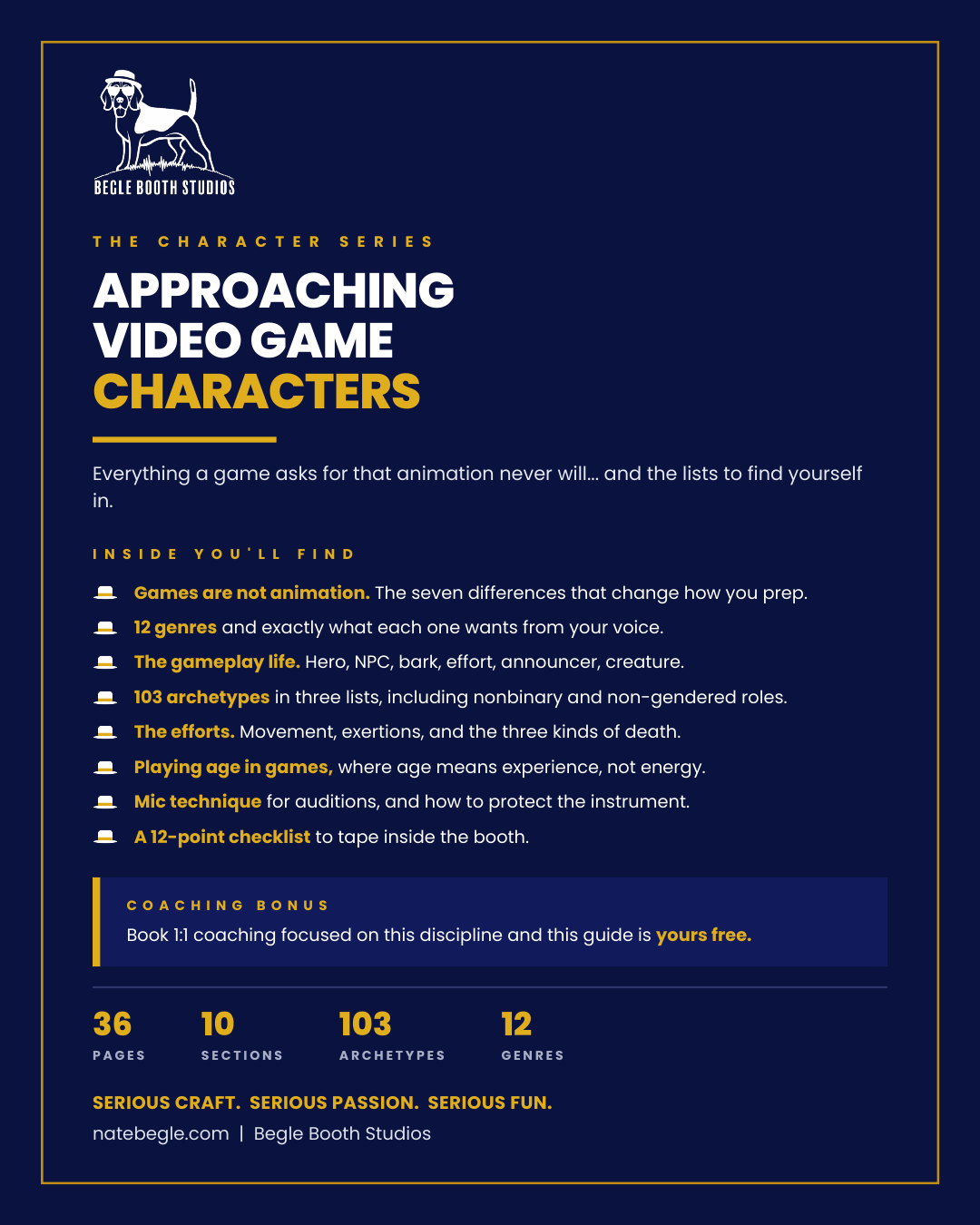 Image 2 of 2
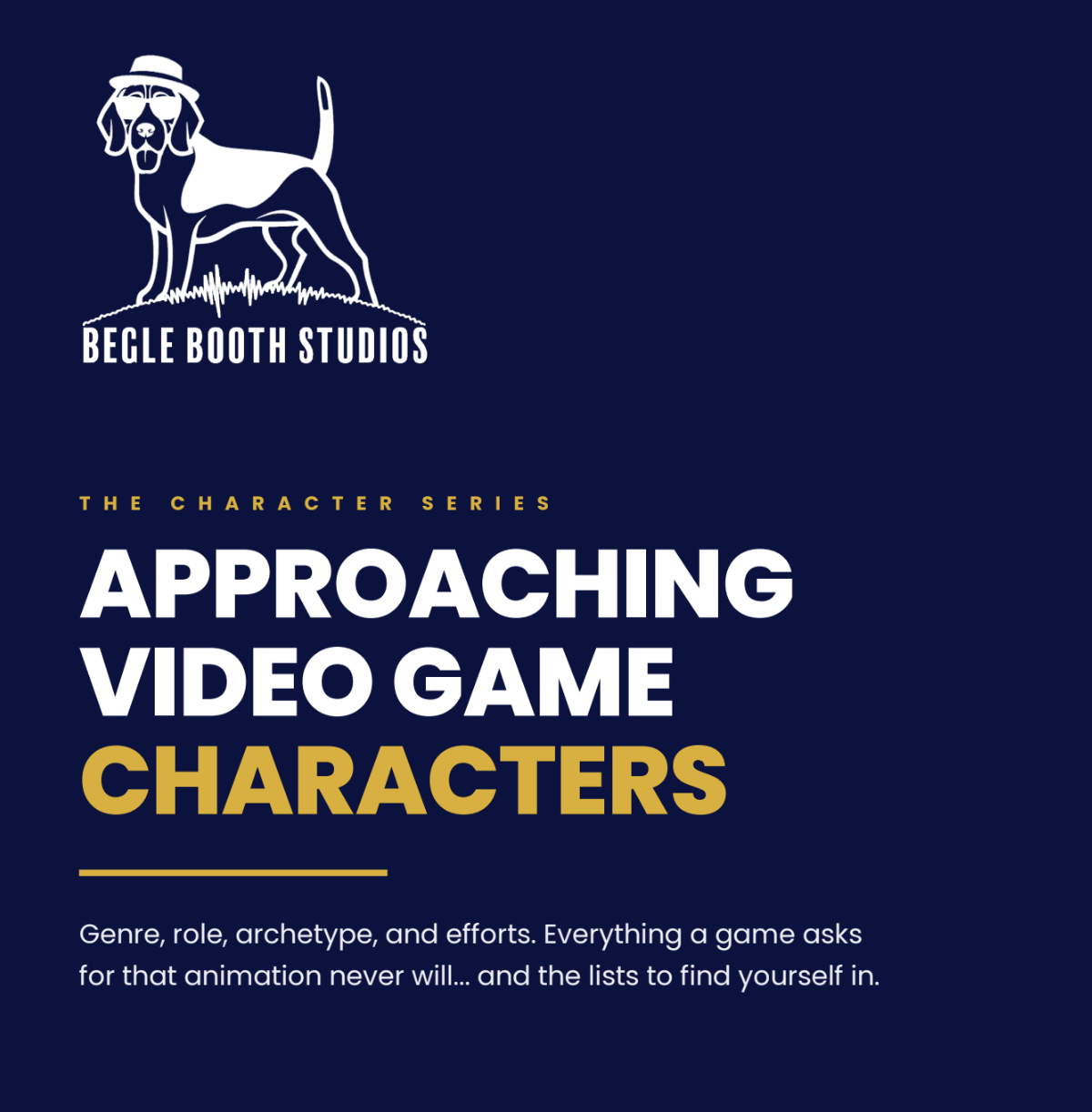
Approaching Video Game Characters
$39.00
Your specs carry more weight than your copy. You record out of order and out of context, forever. Your scene partner is a player who isn't in the room, isn't on the script, didn't read your backstory, and might be eating a sandwich.
Repetition isn't a bug, it's the design.
And roughly half the job has no words in it at all.
I've been working in the game space since 2006, back when my first gig was voicing a stack of NPCs nobody was ever going to put on a poster. My puppetry is what got me into motion capture, and motion capture is what taught me that in games your BODY is doing as much of the acting as your mouth is.
Everything you already know about character work still applies here. This guide is about the seven things that change.
Thirty six pages, ten sections, and three archetype lists.
Games are not animation. The seven differences that change how you prep, every single time. Including why bark sessions are quoted by VARIATION count instead of word count, and what that means for how you perform them.
Twelve genres and exactly what each one wants from your voice. A grunt in a survival horror game and a grunt in a hero shooter are not the same grunt.
The gameplay life. Playable, companion, named NPC, ambient, barks, efforts bank, announcer, creature, performance capture. Nine role types with completely different rules, and the question to ask on every single line.
103 archetypes across male-sounding, female-sounding, and nonbinary or non-gendered lists, with iconic game examples throughout. That third list matters more than most actors realize, because a huge amount of game work is now written for a voice and not a gender, and most people walk right past it.
The efforts. The non-verbal half of the job that almost nobody practices. Movement, exertions, specificity, the vowel work underneath it, and the three kinds of death. Plus how to do all of it without hurting yourself.
Playing age in games, where age means experience rather than energy, and where the gap between how old someone IS and how old they SOUND is usually the whole character.
Mic technique for auditions, treating the microphone as your scene partner's ear.
A twelve point checklist to tape inside the booth and run before you hit send.
Voice actors who want to work in games, and animation actors who keep getting game sides and can tell something is different but can't name what. It's written to be somebody's only go-to in written form, so you can work it top to bottom or keep it open next to your sides.
Want all four lanes? THE APPROACHING SERIES puts Animation, Video Games, Commercial and Dubbing in one PDF for $119. Start with this one and its last page has a code that counts your $39 toward the set.
I'm Nate Begle. Voice actor, audio producer, writer, director, puppeteer and VO coach, twenty five plus years in and working in games since 2006. I did the motion capture performance for the puppet character in The Gunstringer, I'm one of only two performers to play both Crow T. Robot and Tom Servo on MST3K, and I've spent a lot of hours making very specific noises into a microphone on purpose.
Serious craft. Serious passion. Serious FUN.
This guide is yours FREE. If you book 1:1 coaching with me focused on video game work, I'll send you this entire guide at no charge. It's the exact material we'll be working from, so you'll have it in your hands before we ever get on the call. Book a session →
Your specs carry more weight than your copy. You record out of order and out of context, forever. Your scene partner is a player who isn't in the room, isn't on the script, didn't read your backstory, and might be eating a sandwich.
Repetition isn't a bug, it's the design.
And roughly half the job has no words in it at all.
I've been working in the game space since 2006, back when my first gig was voicing a stack of NPCs nobody was ever going to put on a poster. My puppetry is what got me into motion capture, and motion capture is what taught me that in games your BODY is doing as much of the acting as your mouth is.
Everything you already know about character work still applies here. This guide is about the seven things that change.
Thirty six pages, ten sections, and three archetype lists.
Games are not animation. The seven differences that change how you prep, every single time. Including why bark sessions are quoted by VARIATION count instead of word count, and what that means for how you perform them.
Twelve genres and exactly what each one wants from your voice. A grunt in a survival horror game and a grunt in a hero shooter are not the same grunt.
The gameplay life. Playable, companion, named NPC, ambient, barks, efforts bank, announcer, creature, performance capture. Nine role types with completely different rules, and the question to ask on every single line.
103 archetypes across male-sounding, female-sounding, and nonbinary or non-gendered lists, with iconic game examples throughout. That third list matters more than most actors realize, because a huge amount of game work is now written for a voice and not a gender, and most people walk right past it.
The efforts. The non-verbal half of the job that almost nobody practices. Movement, exertions, specificity, the vowel work underneath it, and the three kinds of death. Plus how to do all of it without hurting yourself.
Playing age in games, where age means experience rather than energy, and where the gap between how old someone IS and how old they SOUND is usually the whole character.
Mic technique for auditions, treating the microphone as your scene partner's ear.
A twelve point checklist to tape inside the booth and run before you hit send.
Voice actors who want to work in games, and animation actors who keep getting game sides and can tell something is different but can't name what. It's written to be somebody's only go-to in written form, so you can work it top to bottom or keep it open next to your sides.
Want all four lanes? THE APPROACHING SERIES puts Animation, Video Games, Commercial and Dubbing in one PDF for $119. Start with this one and its last page has a code that counts your $39 toward the set.
I'm Nate Begle. Voice actor, audio producer, writer, director, puppeteer and VO coach, twenty five plus years in and working in games since 2006. I did the motion capture performance for the puppet character in The Gunstringer, I'm one of only two performers to play both Crow T. Robot and Tom Servo on MST3K, and I've spent a lot of hours making very specific noises into a microphone on purpose.
Serious craft. Serious passion. Serious FUN.
This guide is yours FREE. If you book 1:1 coaching with me focused on video game work, I'll send you this entire guide at no charge. It's the exact material we'll be working from, so you'll have it in your hands before we ever get on the call. Book a session →