
 Image 1 of 2
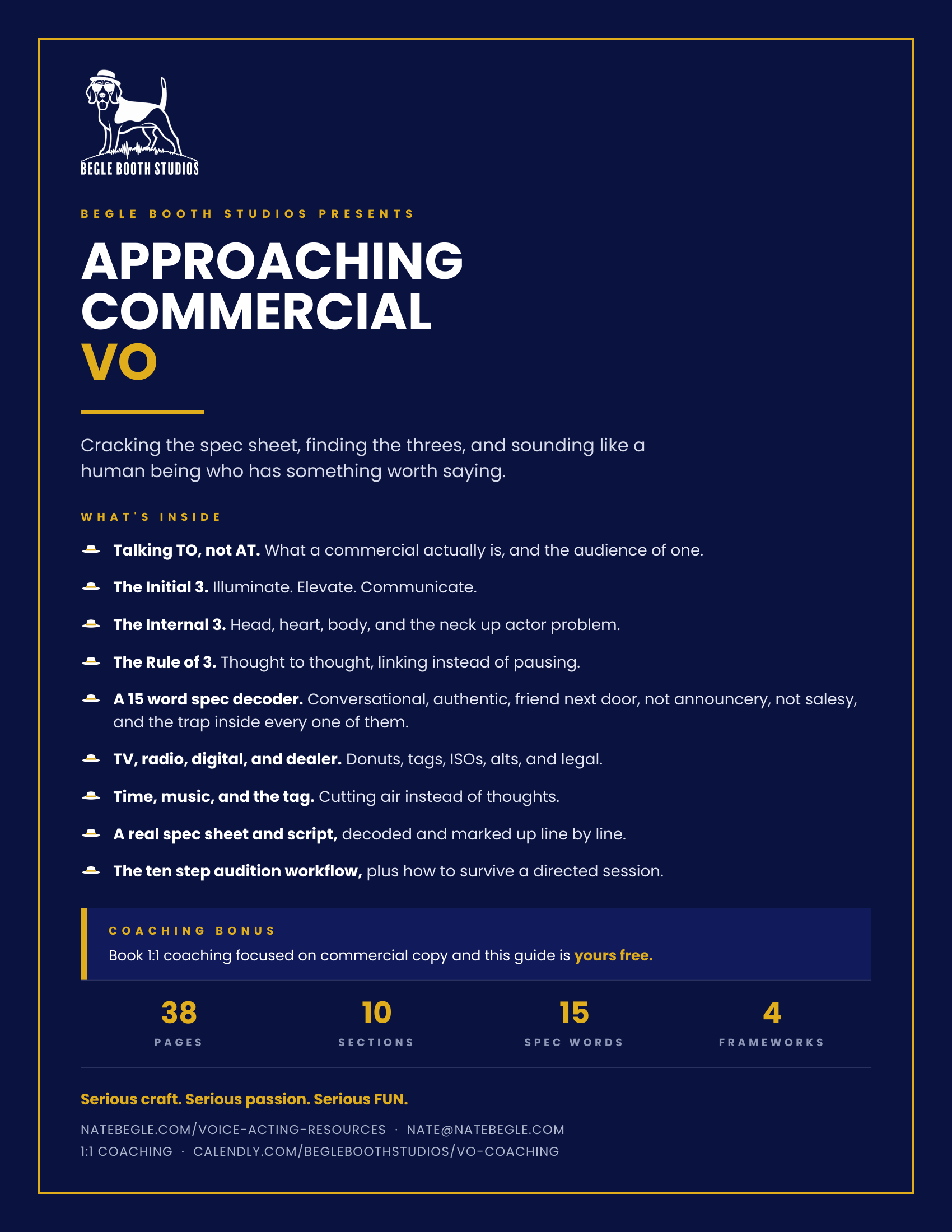 Image 2 of 2
Approaching Commercial VO
$39.00
Cool. What does that MEAN?
You have read that spec sheet. Everybody has read that spec sheet. It shows up on national brands, on regional spots, on dealer copy, on the pre-roll ad your nephew skips. And it is completely useless as a direction, because it is not describing a sound. It is four people in a conference room describing four different feelings they want a listener to have.
So you guess. Then you second guess. Then you record eleven takes and have no idea which one to send, and your confidence goes flying out the booth window while the deadline gets closer.
You are not alone in this. I hear it from voice actors constantly.
I have been saying the same two things to actors for twenty five years.
Voice acting is not about your voice. The words on the page do not matter.
People look at me sideways on that second one. Here is what it means. The words are not the story, they are the EVIDENCE that a story is happening. Your job is the story underneath them... the reason a real human being would ever say these particular words out loud, to one particular other person, right now.
Do that, and "conversational" stops being a mystery. It stops being a tone you put on and becomes the thing that happens automatically when there is somebody real in the chair across from you.
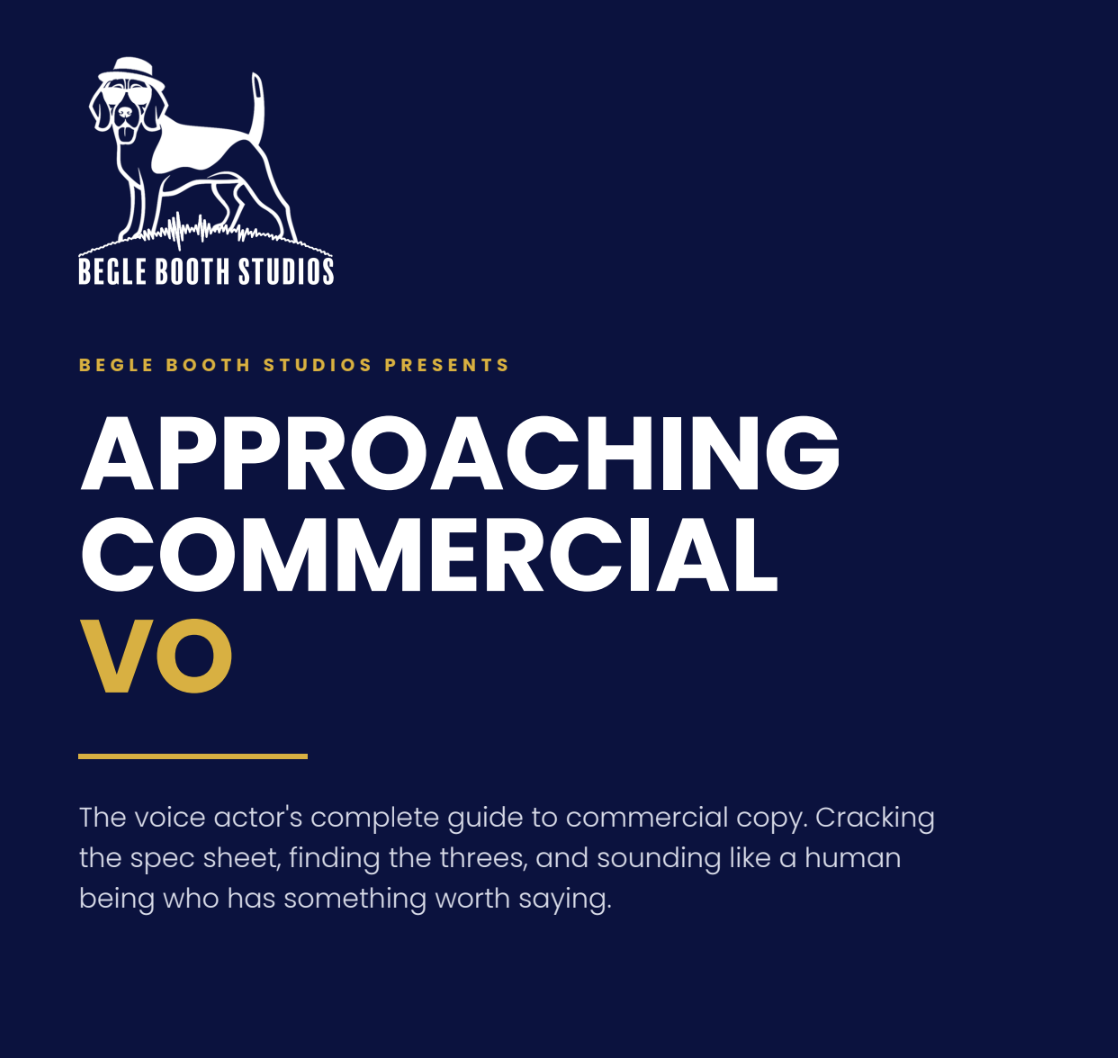
This guide is that whole approach, written down, aimed squarely at commercial copy.
Thirty eight pages. Ten sections. Four frameworks and a fifteen-word decoder.
Talking TO, not AT. What a commercial actually is, why commercial copy has a healing quality, and the audience of one you are always speaking to.
The Initial 3. ILLUMINATE the writer's intent. ELEVATE the words off the page. COMMUNICATE to a specific person. Plus the research method and the four questions to answer before you voice a single word.
The Internal 3. Head, heart, body, and the neck up actor problem that makes forty auditions sound identical.
The Rule of 3. Finding the threes, drawing the triangle in the air, and linking thought to thought instead of pausing your way through a script.
The spec sheet decoder. Fifteen of the words that show up on every commercial breakdown, what the client actually wants when they use them, and the trap each one sets. Conversational. Natural. Authentic. Friend next door. Not announcery. Not salesy. Warm. Upbeat. Confident. Understated. Throw it away. All of it.
TV, radio, digital, and dealer. What changes format to format and what never changes. Plus donuts, tags, ISOs, alts, and how to read legal like a person.
Time, music, and the tag. Why a :30 is not thirty seconds of talking, how to cut AIR instead of cutting thoughts, escaping the commercial melody, and landing a tag without becoming a completely different human being for the last five seconds.
A real spec sheet and a real script, decoded and marked up line by line. National copy, actual client notes, and exactly where the three lives in it.
The ten step audition workflow, how many takes to send, which one to pick, and the audition killers that get you skipped before the second line.
In the session. Translating direction in real time, matching and pickups, and how to be the talent they hire again.
Voice actors who keep getting told their reads sound "a little announcery" and have no idea what to do about it.
Actors from stage or on camera who can absolutely ACT, then freeze the second the copy is thirty seconds long and mentions a website.
Working talent booking plenty of narration who want the commercial side to start paying like the commercial side.
Anybody who has ever recorded eleven takes and had no idea which one to send.
Want all four lanes? THE APPROACHING SERIES puts Animation, Video Games, Commercial and Dubbing in one PDF for $119. Start with this one and its last page has a code that counts your $39 toward the set.
Twenty five years of this. National campaigns for Taco Bell, Verizon, Xbox, Mazda, and Pepsi. Animation for Disney, Nickelodeon, Sesame Street, and The Jim Henson Company. Thirty-plus audiobooks. MST3K. I am also an audio engineer and a puppeteer, which is a weird combination that turns out to be extremely useful when the note is "make it feel real."
This is my jam. It is what I do, it is how I book, and it is how I help other rockstars book.
Serious craft. Serious passion. Serious FUN.
This guide is yours FREE. If you book 1:1 coaching with me focused on commercial copy, I'll send you the entire guide at no charge. It's the exact material we work from, so you'll have it in your hands before we ever get on the call.
Book a session →
Cool. What does that MEAN?
You have read that spec sheet. Everybody has read that spec sheet. It shows up on national brands, on regional spots, on dealer copy, on the pre-roll ad your nephew skips. And it is completely useless as a direction, because it is not describing a sound. It is four people in a conference room describing four different feelings they want a listener to have.
So you guess. Then you second guess. Then you record eleven takes and have no idea which one to send, and your confidence goes flying out the booth window while the deadline gets closer.
You are not alone in this. I hear it from voice actors constantly.
I have been saying the same two things to actors for twenty five years.
Voice acting is not about your voice. The words on the page do not matter.
People look at me sideways on that second one. Here is what it means. The words are not the story, they are the EVIDENCE that a story is happening. Your job is the story underneath them... the reason a real human being would ever say these particular words out loud, to one particular other person, right now.
Do that, and "conversational" stops being a mystery. It stops being a tone you put on and becomes the thing that happens automatically when there is somebody real in the chair across from you.
This guide is that whole approach, written down, aimed squarely at commercial copy.
Thirty eight pages. Ten sections. Four frameworks and a fifteen-word decoder.
Talking TO, not AT. What a commercial actually is, why commercial copy has a healing quality, and the audience of one you are always speaking to.
The Initial 3. ILLUMINATE the writer's intent. ELEVATE the words off the page. COMMUNICATE to a specific person. Plus the research method and the four questions to answer before you voice a single word.
The Internal 3. Head, heart, body, and the neck up actor problem that makes forty auditions sound identical.
The Rule of 3. Finding the threes, drawing the triangle in the air, and linking thought to thought instead of pausing your way through a script.
The spec sheet decoder. Fifteen of the words that show up on every commercial breakdown, what the client actually wants when they use them, and the trap each one sets. Conversational. Natural. Authentic. Friend next door. Not announcery. Not salesy. Warm. Upbeat. Confident. Understated. Throw it away. All of it.
TV, radio, digital, and dealer. What changes format to format and what never changes. Plus donuts, tags, ISOs, alts, and how to read legal like a person.
Time, music, and the tag. Why a :30 is not thirty seconds of talking, how to cut AIR instead of cutting thoughts, escaping the commercial melody, and landing a tag without becoming a completely different human being for the last five seconds.
A real spec sheet and a real script, decoded and marked up line by line. National copy, actual client notes, and exactly where the three lives in it.
The ten step audition workflow, how many takes to send, which one to pick, and the audition killers that get you skipped before the second line.
In the session. Translating direction in real time, matching and pickups, and how to be the talent they hire again.
Voice actors who keep getting told their reads sound "a little announcery" and have no idea what to do about it.
Actors from stage or on camera who can absolutely ACT, then freeze the second the copy is thirty seconds long and mentions a website.
Working talent booking plenty of narration who want the commercial side to start paying like the commercial side.
Anybody who has ever recorded eleven takes and had no idea which one to send.
Want all four lanes? THE APPROACHING SERIES puts Animation, Video Games, Commercial and Dubbing in one PDF for $119. Start with this one and its last page has a code that counts your $39 toward the set.
Twenty five years of this. National campaigns for Taco Bell, Verizon, Xbox, Mazda, and Pepsi. Animation for Disney, Nickelodeon, Sesame Street, and The Jim Henson Company. Thirty-plus audiobooks. MST3K. I am also an audio engineer and a puppeteer, which is a weird combination that turns out to be extremely useful when the note is "make it feel real."
This is my jam. It is what I do, it is how I book, and it is how I help other rockstars book.
Serious craft. Serious passion. Serious FUN.
This guide is yours FREE. If you book 1:1 coaching with me focused on commercial copy, I'll send you the entire guide at no charge. It's the exact material we work from, so you'll have it in your hands before we ever get on the call.
Book a session →